Hawthorne, “Feathertop”; MacDonald, “The Magic Mirror”
ENG 108 · Lecture 5
Erik Fredner
Oregon State University
Thu Oct 8, 2026
Adapted from course materials by Evan Gottlieb.
Quiz 4
Time use survey
Vote
Oregon residents have until Tuesday, October 13 to register.
Questions for today
- Why did the nineteenth century want fantasy?
- How does each story bring us into the fantastic: through a door, or by dropping us in?
- What is allegory? Are these allegories?
- Is fantasy an escape from the modern world, or an enchanted alternative to it?
Why fantasy in the nineteenth century?
The Mechanical Age
Were we required to characterise this age of ours by any single epithet, we should be tempted to call it, not an Heroical, Devotional, Philosophical, or Moral Age, but, above all others, the Mechanical Age.1
- Britain industrializes earliest, and the US follows soon after.
- Industrialization creates the modern world: factories, railways, telegraphs, cities, etc.
- Everything must have a price. So everything must be measured (goods, time, work, etc.)
- Explanatory power of science grows: geology, evolution, statistics, etc.
The disenchantment of the world
…given the rationalization and intellectualization of the times, and especially given the disenchantment of the world—its loss of magic—the ultimate and most sublime values have retreated from public life, into either the otherworldly realm of mysticism or the direct brotherly communities of individuals with one another.
Increasing rationalization…means something else: the knowledge, or belief that we could find out if we wanted to; that in principle there are no mysterious incalculable forces intervening in our lives, but instead all things, in theory, can be mastered through calculation. It means the disenchanting of the world.2
How fantasy responds to disenchantment
- Fairy tales: The Grimms appear in English in 1823.
- Folklore: The term folk-lore is coined in 1846.
- Romanticizing the Middle Ages: the Pre-Raphaelite painters (1848), Tennyson’s Idylls of the King (1859–85), William Morris’s handicrafts and romances.
MacDonald and fantasy for grown-ups
- Modern speculative fiction (SF) is often ambiguous about the age of its readers. Children, young adults, and adults are all possible.
- MacDonald subtitles Phantastes (1858), the book from which “The Magic Mirror” is excerpted, “A Faerie Romance for Men and Women.”
Escape or enchantment?
In 2026, do you think that fantasy functions more as an escape from the real world, or as a way of enchanting everyday life? How about for people in the 1800s? Is there a difference between its role in each of those times? If so, what is it?
Tolkien’s answer
Why should a man be scorned, if, finding himself in prison, he tries to get out and go home?3
- The “Escape of the Prisoner” vs. the “Flight of the Deserter”
- Tolkien’s example: He finds electric street-lamps, “so typical a product of the Robot Age,” to be elaborate, ugly, and inferior to their predecessors
- People who described electric street-lamps as inevitable or inexorable “worship” them, whereas the prisoner wishes to escape from that line of thinking entirely
Prisoners?
- Do you sympathize with this desire to escape from or re-enchant the modern world today? Why or why not?
- If so, do you think fantasy is a good way achieve this goal? What are other possible approaches?
How do we enter fantasy?
Portal-quest vs. immersive fantasy
Farah Mendlesohn sorts fantasy by how stories introduce fantastic elements to the reader.4
- In portal fantasy, a character leaves one world (usually recognizable as the real world), and enters another (usually recognizable as fantastical).
- Alice visits Wonderland. Harry goes to Hogwarts. Luke leaves Tatooine.
- In immersive fantasy, the reader enters directly into the fantastic world, and the characters usually do not recognize its fantastical elements as fantastic.
- Characters in Game of Thrones think Westeros is the world.
What about the stories for today?
- Would you say that “Feathertop” and “The Magic Mirror” are more like portal fantasies or immersive fantasies? How do you know?
- How about other stories we have read? “Hans-My-Hedgehog,” “Transformation,” etc.
Evidence
- “Feathertop” as immersive: Witches like Mother Rigby exist. Rigby’s magic can be perceived as magic (e.g., by Polly Gookin on seeing Feathertop in the mirror). However, the narrator expresses some skepticism about the magic (“Whence the coal came, and how brought thither by an invisible hand, I have never been able to discover.”)
- “Magic Mirror” as portal: The enchanted mirror is a “door” to another world (one where Cosmo and Princess von Hohenweiss can be together). Cosmo learns how the mirror works, which explains it to readers along the way. The destruction of the mirror closes the portal.
Nathaniel Hawthorne
“Feathertop: A Moralized Legend” (1852)
A few things about Hawthorne
- A major author in the traditional US literary canon.
- In the 1800s, Americans were anxious about their low literary accomplishment relative to European authors. Hawthorne was one of a few early US fiction writers (along with Irving and Poe) who were internationally successful.
- Best known for The Scarlet Letter (1850).
- He called his books romances, not novels, claiming “a certain latitude” that realism did not allow.5
The characters of “Feathertop”
Describe the relationships among the main characters: Mother Rigby, Feathertop, Justice Gookin, and Polly Gookin. What are they each like? What do they want from each other?
“Allegory: a moralized legend”
Allegories symbolize moral or political ideas in narrative. Personification is a common feature of allegories.
A recent example

The Politician, blinded by the Flag, does not know that he is about to step into the unknown.
Allegories in SF
- Feathertop is a gentleman in appearance only: He has the clothes, gait, a few turns of phrase, but if you look closely, he’s not even a person.
- “Feathertop” is moralized: the meaning is stated outright. Mother Rigby says the world is full of “coxcombs and charlatans” who “never see themselves for what they are.”
- Feathertop’s story is an allegory for other such men, and the magical element makes the allegory satirical, too. Such men are really no better than gussied up scarecrows.
- Ironically, Feathertop had “too much heart” for “such an empty and heartless world.”
Feathertop today
- Do you think that the “moralized legend” of Feathertop continues to resonate today? In what ways?
- If the allegory of Feathertop seems similar to anything you observe about the world today, how do you recognize the connections between them? In other words, how can you recognize that this allegory from the mid-nineteenth century applies to something specific today?
George MacDonald
MacDonald in brief
- Scottish Congregationalist minister who lost his pulpit in 1853 for insufficient dogmatism.
- Read and translated the German Romantic Novalis; drew on the Bible, Celtic legend, the Grimms, and Andersen.
- A friend of John Ruskin and Lewis Carroll.
- Influenced Lewis Carroll (Alice’s Adventures in Wonderland), C.S. Lewis (Chronicles of Narnia), and J.R.R. Tolkien (Lord of the Rings).
- Phantastes (1858) is his major book. “The Magic Mirror” is an inset story.
What does Cosmo see in the mirror?
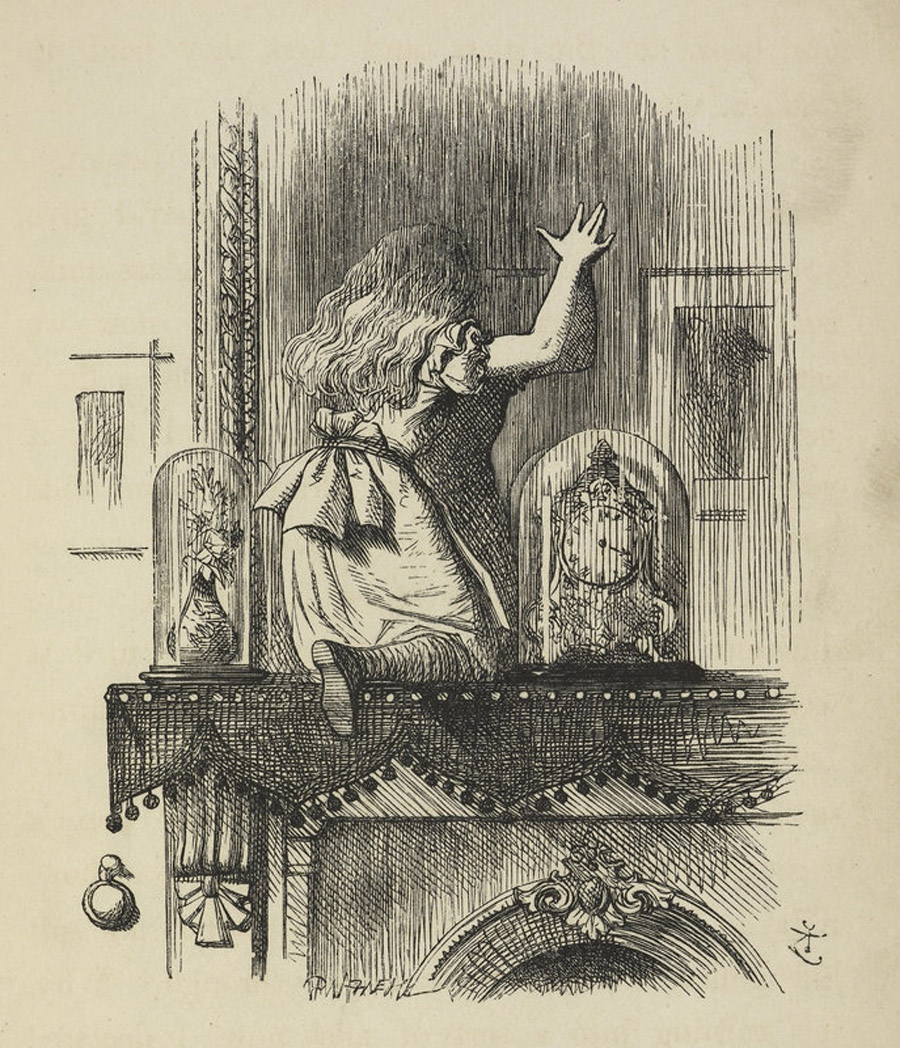
What a strange thing a mirror is! and what a wondrous affinity exists between it and a man’s imagination! For this room of mine, as I behold it in the glass, is the same, and yet not the same. It is not the mere representation of the room I live in, but it looks just as if I were reading about it in a story I like. All its commonness has disappeared. The mirror has lifted it out of the region of fact into the realm of art.
Re-enchanting the ordinary
- A mirror adds nothing to Cosmo’s room. Except a frame (and his reflection).
- With the frame, it appears to be the same “and yet not the same.”
- This is a fantasy that enchants the world. A student’s empty room becomes magical.
Mirrors are magic
Posessiveness and estrangement
- We have talked about how SF makes the familiar unfamiliar using the term estrangement.
- Tolkien, who read MacDonald closely, described this as the recovery of the world, especially the recovery of the magic of childhood.
We need, in any case, to clean our windows; so that the things seen clearly may be freed from the drab blur of triteness or familiarity—from possessiveness.6
Not an allegory
A fairytale is not an allegory. There may be allegory in it, but it is not an allegory.7
- Hawthorne tells us the moral of the story. MacDonald doesn’t.
- However, MacDonald’s story connects to commonplace ideas like, “If you love someone, you must let them go.”
- “If thou lovest me, set me free, even from thyself.”
Why doesn’t “The Magic Mirror” have a happy ending?
- What usually happens in fantasy stories when a protagonist rescues a princess?
- How does MacDonald use that horizon of expectation narratively?
Extra Credit Book Club
- If you have not already communicated with your ECBC members, do so now
- Decide how you will communicate (e.g., group chat)
- If possible, set a time for your first meeting
- If any of your group members are absent, make sure to email them!