Paper Girls, Issues 1–5
ENG 108 · Lecture 2
Erik Fredner
Oregon State University
Tue Sep 29, 2026
Adapted from course materials by Evan Gottlieb.
Quiz #1
Review
“Horizon of expectation”1
- Genres help readers decode and appraise new texts through prior experience with similar texts.
- Without prior SF reading, you can’t tell which elements of a given story are SF conventions, and which are specific to this work.
- But if you have read a lot of science fiction, you can recognize recurring elements (e.g., future settings, alien contact, time travel, new technologies, etc.) as science fictional
“Estrangement and cognition”2
- “Estrangement” means that we feel at some remove from the world as we know it.
- “Defamiliarization” is also sometimes used to describe this sensation.3
- Why “estrangement and cognition?”
- It’s possible for something to be estranging without being thought-provoking
- Suvin says fantasy does this
- AI slop is a good contemporary example
- Estrangement and defamiliarization demonstrate the power of art to see the world anew.
A famous example of estrangement

For most of the 20th century, speculative fiction (SF) was not considered literature
- Literature was imaginative and aesthetically ambitious writing, especially poetry, fiction, and drama.
- SF was considered entertainment, not literature, art, or philosophy
- Literature was valued because it rewarded careful, repeated reading
- SF was valued as quick and entertaining reading.
- Its modes of production and distribution reflected this:
- Mass-market printing, pulp, genre fiction, often advertised to young readers
SF print modalities then
Aesthetic judgments that genres like SF were “trashy” reflect its modes of production:
Senarens, Frank Reade, Jr., and His New Steam Man (1892), in the University of South Florida’s Frank Reade Dime Novels Collection.
SF print modalities now
Consumer culture has radically changed SF print modalities, such that SF collector’s editions ($100 to $250+) are much more expensive than most mass-produced hardcovers ($25-$40):
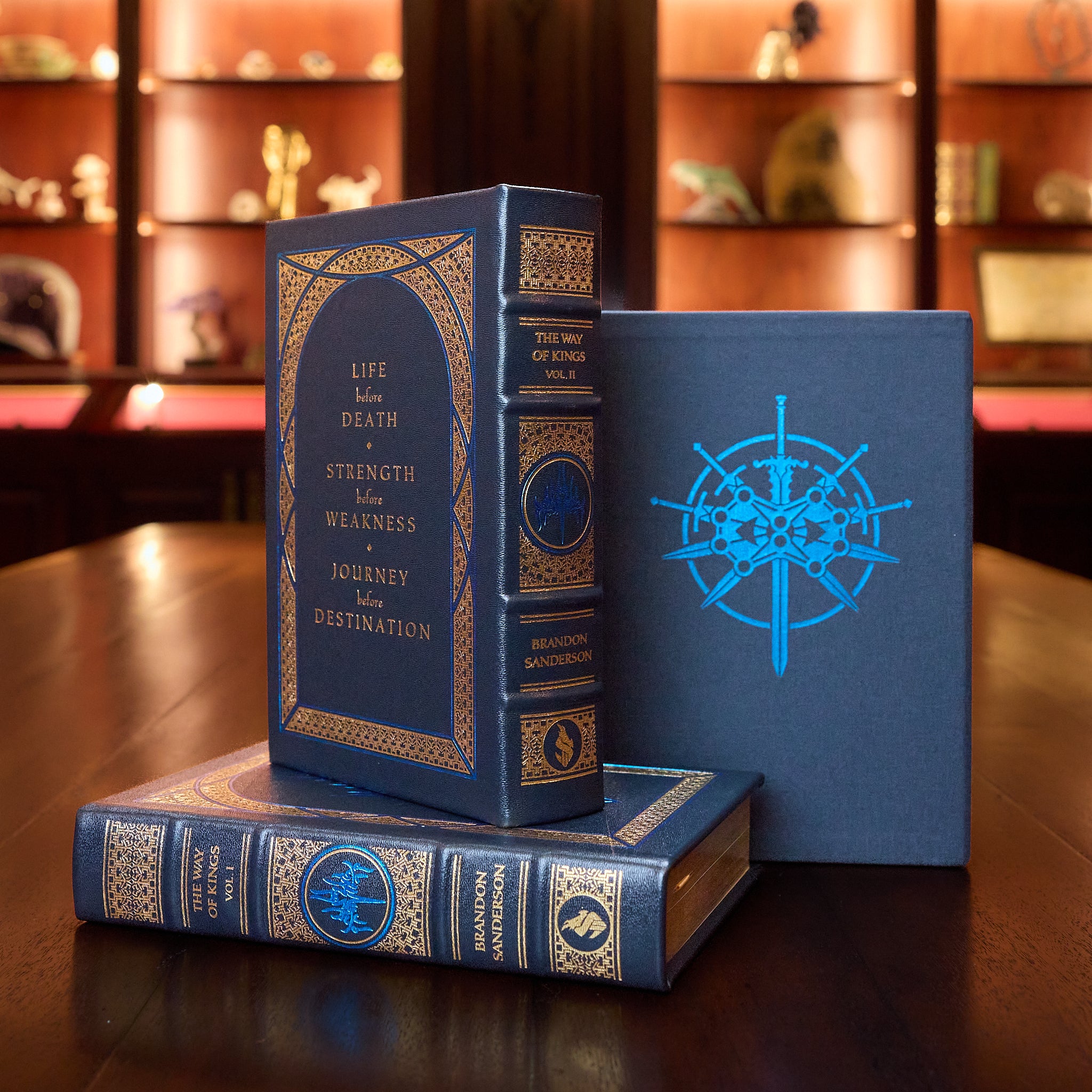
SF print modalities now, continued
The Folio Society produces expensive editions of literary works, including the traditional literary canon, such as Shakespeare and Jane Austen:
:fill(white)/https://www.foliosociety.com/static/media/catalog/product/2/2/SCPC_1_base.jpg)
But the same company also produces editions of contemporary SF like The Martian:
:fill(white)/https://www.foliosociety.com/static/media/catalog/product/m/a/mart-01-base.jpg)
Print modalities and their implicit audiences
- Pulps, newspapers, magazines: Cheap paper, cheap printing, affordable to a lot of the literate population, including those with relatively little leisure time to read (short articles, short stories, etc.)
- Mass-market paperbacks, trade paperbacks: More expensive than newspapers and magazines, but cheaper than hardcovers. Targeting a wide audience with some disposable income and some leisure time.
- Hardcover and collector’s editions: The most expensive editions targeting people who have disposable income, leisure time to read, and pay attention to literary production either as fans or connoisseurs.
- The Lord of the Rings has appeared in most of these modalities.
Print modalities and their implicit audiences, continued
- In general, literary fiction debuted in more expensive formats (e.g., hardcover with dust jackets), and was later published in cheaper formats (e.g., trade paperbacks and mass-market paperbacks)
- This implies a potential movement from elite culture to mass culture.
- In general, SF debuted in cheaper formats (e.g., pulps, mass-market paperbacks), and was later published in more expensive formats to indicate its consecration (e.g., collector’s editions)
- This implies a potential movement from mass culture to elite culture.
What is a novum?
- Latin for “new thing”
- A device, especially in science fiction, that makes a fictional world recognizably different from the author’s.
- The novum causes both estrangement and cognition.
- e.g., time travel
What is close reading?
- Focusing intensively on choices in one or more parts of a text
- Interpreting the relationship between choices made in those parts and the text as a whole
A classic example of close reading from SF
- Why is it called The Wonderful Wizard of Oz (1900)?4
- “Ounces” is abbreviated “oz.” Gold is measured in ounces.
- In the 1896 US presidential election, the biggest point of debate was the gold standard. Should the dollar be backed by gold alone, or by gold and silver?
- “Free silver” would put more money in circulation, which would have helped indebted farmers.
- Keeping the gold standard favored banks and creditors.
- Dorothy walks the yellow brick road in silver shoes (the film changes them to ruby).
- At the end of the gold road, there is an allegedly powerful wizard who turns out to be a fraud.
- Dorothy then learns that her silver shoes could have taken her home all along.
- Interrogating one word (“Oz”) reveals this latent meaning.
What is the relationship between comics and SF?
Comics and speculative fiction (SF) are closely connected
- Not all comics are SF
- e.g., Charles Schulz’s Peanuts is not
- But many of the most popular comics are SF
- Superheroes like Spider-Man
- Fantasy comics like Monstress
- Horror comics like Swamp Thing
How is Paper Girls similar to other comics?
Similarities
- Published in individual issues (serialized)
- Sequential art (i.e., ordered panels with gutters)
- Art style is cartoony (simplified and expressive)
- Speech bubbles with lettering
- Sound effects (e.g., BLAM)
- Emphasis on spectacle
- There is not one “author”—it’s a team effort (writer, artist, colorist, letterer)
How is Paper Girls different from other comics?
Differences from other comics
- Stars four twelve-year-old girls rather than adult men
- Story is set in a specific time and place: suburban Ohio on November 1, 1988
- Finite story with a planned ending, not an unlimited serial (Batman can always save Gotham from another villain)
- Invented symbols for the “alien” language (aliens are often able to communicate in English)
Which speculative fiction traditions does Paper Girls connect itself to? And how do you know?
Think about your own “horizon of expectation” for SF, or what kind of “contract” an SF reader enters into.
Connections to SF traditions
- Explicit references to SF works (e.g., The War of the Worlds)
- Kids-on-bikes iconography links to E.T. (1982)
- Horror movies (Halloween costumes)
- Futuristic technology (e.g., time travel, ray gun)
- Cyborgs
- “Alien” languages (unknown symbols, future English dialect)
- Prehistoric creatures (pterosaurs)
How does Paper Girls distinguish itself from the SF tradition?
Distinctions from the SF tradition
- Science fiction is usually set in the future, but PG is set in an alternate version of its authors’ past
- Alternate history overlaps with real history (e.g., Reagan)
- Heroes are ordinary girls in Ohio working a paper route, not scientists or chosen ones
- Old technology like walkie-talkies emphasized
- Girls don’t understand the science, so neither do the readers
- Generational conflict (kids vs. adults, present vs. future) rather than e.g., human vs. alien
How would you describe the personalities of the paper girls?
And how does the comic communicate these characteristics to you? Point to specific examples in the text.
The paper girls
- Erin Tieng: “the new girl.” Kind, rule-following, sensitive
- Tiffany “Tiff” Quilkin: smart, optimistic, interested in technology (e.g., walkie-talkies, video games)
- MacKenzie “Mac” Coyle: the first girl to deliver papers in the area, quick to anger, uncomfortable with emotion, uses homophobic slurs, seemingly poorer than some of the other paper girls
- Karina J. “KJ” Brandman: intelligent, loyal, athletic (field hockey), guarded
What relationships exist between the words and images at the beginning of Paper Girls?
Consider the change from Erin’s dreaming world to her waking world over the first pages.
Seven types of word–image relationship5
- Word specific — the words tell the narrative; the image ornaments it.
- Picture specific — the inverse.
- Duo specific — words and images carry the same message.
- Additive — the words amplify or elaborate an image that is telling the story, or vice versa.
- Parallel — words and images run on apparently separate tracks.
- Montage — words are absorbed into the image and become part of it.
- Inter-dependent — words and images convey something together that neither could convey independently
The artists on the look of Paper Girls
What are some of the themes that you see developing in PG?
Themes and topics
- Coming-of-age
- Childhood vs. adulthood
- 1980s US suburbia
- Friendship
- Sexism
- Homophobia
- Class
- Media (e.g., newspapers)
- Communication
- Taking responsibility for the consequences of your decisions
What do you make of the language of the time-traveling teenagers, Heck and Naldo?
Why do you think that the artists chose to represent their speech this way? What effect does it have on the reader and the text?
The language of the time-traveling teenagers
- Heck and Naldo speak a future English that the book renders in unfamiliar symbols, but it’s a substitution cipher.
- This means that each symbol directly corresponds to one English letter or punctuation mark.
- Puzzles, codes, and ciphers like this are common in SF texts.
- Solving these is a different kind of “close reading” than the interpretive close reading we were discussing before.
Can you connect some of the topics we discussed in the first class to PG?
Main points from today
- Genres like science fiction and fantasy set specific expectations for readers.
- Those expectations can be fulfilled or unfulfilled, each of which has a different narrative or aesthetic effect.
- Paper Girls fulfills many SF concepts, but undercuts others.
- SF’s changing cultural status is evident in how it has been printed, and who the expected buyers of those copies are.
- Comics are an important medium for SF.
- Comics have distinctive formal features that require us to read them in particular ways (e.g., panels and gutters).
- Close reading takes a detail (e.g., Oz), studies it carefully, and reflects on its broader significance.
Reminders
- If you don’t yet have your copies of BBCF and BBSF, I have sent links for Thursday’s readings. But I will not be able to do that going forward.
- If you want to participate in the Extra Credit Book Club, please fill out that survey by Thursday.