Introduction to Science Fiction and Fantasy
ENG 108 · Lecture 1
Erik Fredner
Oregon State University
Fall 2026
Introductions
- Your preferred name
- Your pronouns
- A work of science fiction or fantasy in any medium that you enjoy, and one reason why
Example
- Preferred name
- Professor Fredner
- Pronouns
- He/him
- A work of science fiction or fantasy in any medium that you like or dislike, and one reason why
- The Phantom Tollbooth got me interested in reading as a child.
Course goals
The abbreviation “SF” stands for “speculative fiction,” which is an umbrella genre that includes science fiction and fantasy.
- Read SF!
- Identify the formal features of science fiction and fantasy
- Describe the relationships between science fiction and fantasy
- Understand SF in relation to the material conditions of its production
- Practice close reading
Reading SF
- Reading is the main point of this class.
- But reading is not natural.1
Tips for reading literature
- If you haven’t read a novel or short story in a while, you are out of practice. That’s ok.
- The more you practice, the easier reading gets.
- Reading on paper confers a statistically significant advantage in comprehension compared to reading on screens.2
- Writing about your reading (e.g., outlining, annotating, rephrasing) also helps comprehension.3
Syllabus
We’re going to briefly touch on key points of the syllabus together, but you are expected to read the syllabus in full.
Key terms
What is “literature?”
The answer changes over time:
- Pre-modern: All writing (litterae), and the learning that comes with it
- Late 17th–18th c.: Vernacular writing (e.g., in English), defined against Greek and Latin.
- 18th c.: Tied to new print genres (periodical essay, familiar letter, novel) and to print’s effects on public debate and private consumption. “Literature” also becomes a model of good style and taste, and a standard dialect, from which comes the idea of a national literature (e.g., American literature).
- Later 19th c.: Restricted to imaginative genres: poetry, novels, plays. Distinguished against scientific and informational writing, which are “non-literary.” The essay is stuck in between.
- 20th c.: Narrowed again by the split between scientific and literary claims to knowledge; literature is redefined as a kind of language (“literariness”), which can be found in non-literary texts.
- Mid-20th c.: Popular fiction and poetry (like SF) demoted to “genre” or sub-literary writing. High Modernism (e.g., Proust, Woolf, Joyce, Faulkner, Kafka, Eliot, Stein, Pound, Beckett) made exemplary. “Bad” writing has been reclassified, so “bad literature” becomes a contradiction in terms.4
Why does the definition of “literature” matter for this course?
- For most of its history, SF was not considered literature.
- Some people still don’t think it’s literature.
- The way we discuss “literature” in this class differs from other ways this word is used today.
- e.g., The section labeled “literature” in book stores is often comprised primarily or exclusively of literary fiction, mostly novels.
If it wasn’t literature, what was SF considered?
- Entertainment (not Art or Philosophy)
- “Low culture,” (mass culture) not “high culture” (prestige culture)
- Low culture examples: TikTok, Billboard Top 100, Marvel Cinematic Universe
- High culture examples: poetry, opera, painting
- Mass culture can be profitable.
- Prestige culture typically is not (subsidized by benefactors, “art for art’s sake”).
- Pulp fiction (i.e., produced on cheap paper)
- Genre fiction (i.e., principally of interest to fans of the genre; product-market fit)
- Literature for young people
What changed?
- Arguably, SF became the dominant genre of popular narrative media.
- e.g., The Lord of the Rings (1954-55), Star Wars (1977), superhero stories.
- One reason for this is the (hotly debated) transition from a textual culture to a visual culture.5
- SF lends itself to spectacle.
- Especially after the New Wave of the 1960s and 70s, SF began to be taken seriously by critics and scholars.
- Literary authors increasingly wrote from within or adjacent to genre fiction.
- e.g., Toni Morrison’s Beloved (1987) is a ghost story.
Bourdieu’s cultural field
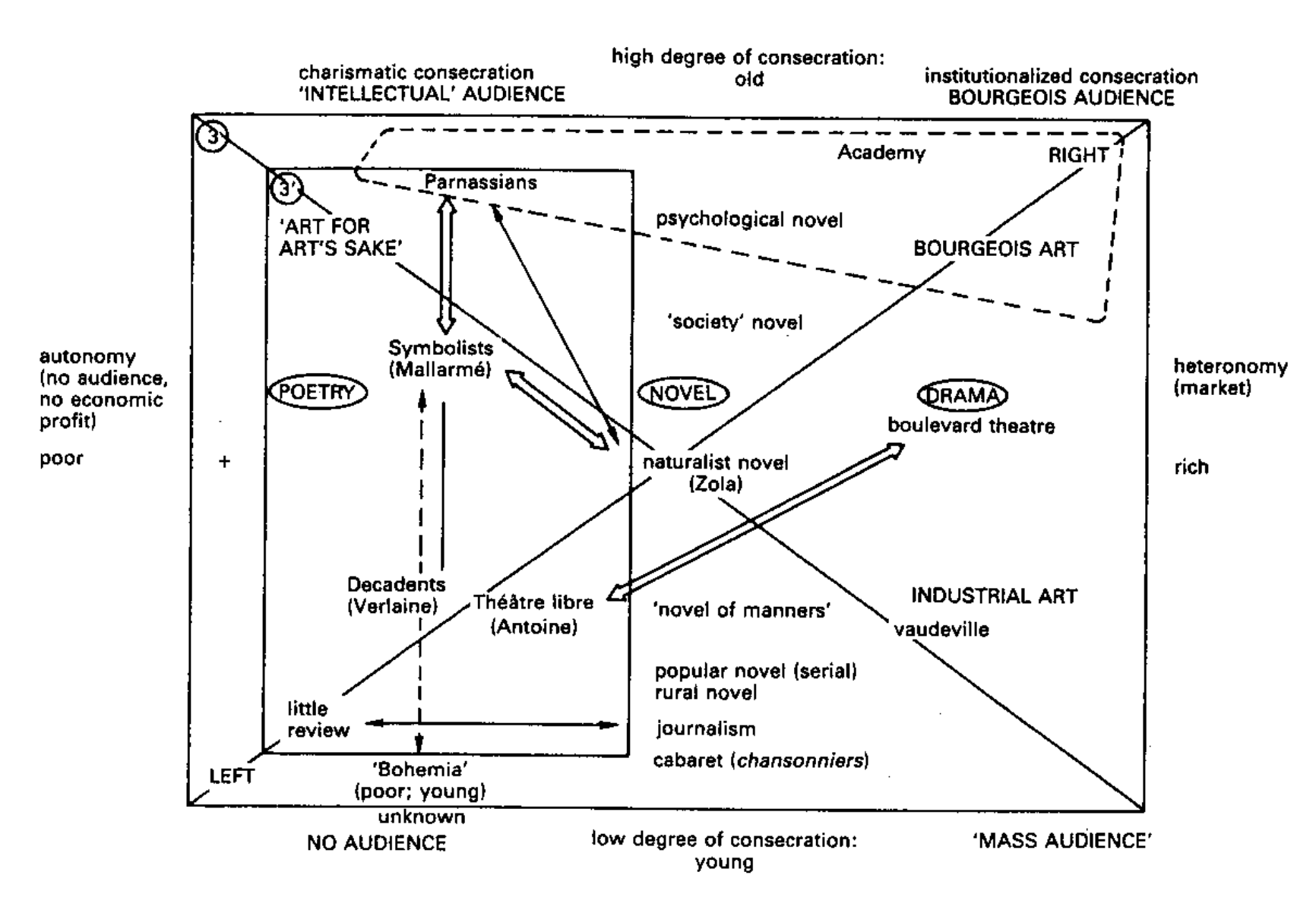
Bourdieu’s cultural field adapted to the contemporary US
Audience size against consecration (all guesses!).7
Genre
What is genre?
- A genre is a category that groups similar works of art together.
- Figuring out how a given work of art relates to one or more genres gets complicated.
- One of the most influential characterizations is that genre works as a horizon of expectation.8
- Prior experiences with similar texts allow a reader to decode and appraise new texts.
What are some examples of genres?
Genres become clear when expectations are unfulfilled
- Is a portrait a portrait without a human subject?
- Is a sitcom a sitcom without recurring characters?
- Is hip-hop hip-hop without rapping?
Genre example: “Old Town Road”
- In 2019, Lil Nas X’s song “Old Town Road” charted on Billboard’s Hot 100, Hot Country Songs, and Hot R&B/Hip-Hop Songs.9
- Billboard then removed it from Hot Country Songs, arguing that it didn’t fit the genre.10
- Which expectations of country music as a genre were unfulfilled?
SF and genre
Is speculative fiction (SF) a genre?
- Some argue that SF is a genre with a set of subgenera (like science fiction and fantasy) with some shared conventions.11
- e.g., Science fiction is usually set in the future. Fantasy is usually set in the past. Neither is usually set in the present.
- The video game Split Fiction (2025) dramatizes this generic connection.
- Others argue that SF is a mode, a method or discourse that can appear in works of multiple genres.12
- e.g., Blade Runner is a science-fictional detective story.
What do fantasy and science fiction have in common?
- Fantastic difference(s) from consensus reality13
- Imagining other ways of being in the world
- Interested in times other than the present (past, future, or alternate histories)
A definition of fantasy
Fantasy texts and narratives “deal in the juxtaposition of competing worlds, wherein one world, purportedly representing ‘reality,’ is left behind in preference for another which is unknown and ‘foreign’ in the sense of being strange, fabulous, or grotesque…the laws of physics, logic, time, physiognomy, life and death and/or geography are usually subverted in preference for a narrative vision which is improbable, impossible, or beyond belief.”14
Famous examples of fantasy
- Grimms’ fairy tales (e.g., “Cinderella”)
- Alice in Wonderland
- The Wizard of Oz
- The Lord of the Rings
- Magical realism (e.g., One Hundred Years of Solitude)
- Dungeons & Dragons
- Harry Potter
- Avatar: The Last Airbender
- Spirited Away
- Game of Thrones
A definition of science fiction
Science fiction is “a literary genre whose necessary and sufficient conditions are the presence and interaction of estrangement and cognition, and whose main device is an imaginative framework alternative to the author’s empirical environment.”15
Famous examples of science fiction
- Frankenstein
- The War of the Worlds
- Nineteen Eighty-Four
- Godzilla
- I, Robot
- Star Wars
- Dune
- The Matrix
- Stranger Things
- Black Mirror
The novum
- SF becomes SF by being recognizably different from the author’s world.
- A literary device used to achieve this, especially in science fiction, is the novum (Latin for “new thing”)
- Time travel as in H. G. Wells’s The Time Machine (1895) is an exemplary novum
“An imaginative framework alternative to” what?
Realism as SF’s other
- Realism attempts to represent the ordinary; SF attempts to represent the extraordinary.
- Realism attempts to represent “things as they are;” SF attempts to represent “things as they aren’t.”16
Reading
How we will read
- Take the time to read the texts in full. It’s your main assignment.
- Recognize shared conventions and connections across multiple texts.
- Think about what happens and why (“read for the plot”).17
- Identify relationships between linguistic details in specific parts of the text, and the text as a whole (“close reading”).
What is “close reading?”
- Close reading has been the predominant method of literary studies since the twentieth century.
- Definitions and practices vary over time.18
- A useful recent account defines it as a series of actions taken by a reader:
You read a poem, play, essay, story, or novel; you start with someone else’s words; you see something in those words that means something to you, though you probably don’t know what yet. Maybe what you see confuses you or riles you up, maybe it surprises you, maybe it charms or delights you. You pause; you reread; suddenly the thing you noticed starts to feel central, or even crucial, like a hidden center of gravity that draws in and changes everything around it. The work of literature becomes clearer, or more complicated, or both, and is slightly or maybe tremendously reshaped. No longer just something to read, the work becomes something to study. It becomes what literary scholars call “a text”—that large category including poems, plays, essays, stories, novels, and much besides—objects of special interest and attention, things to discuss, analyze, and interpret. And now you might look up from the text because you want to show what’s happened to someone else. You want to explain something to another person: your own reader. You want to persuade, to teach. You want to say, you should understand this poem, play, essay, novel, or story in light of this detail, you should understand it this way. You want to say, it matters not to miss or misunderstand this.19
Practice: “On Exactitude in Science”
…In that Empire, the Art of Cartography attained such Perfection that the map of a single Province occupied the entirety of a City, and the map of the Empire, the entirety of a Province. In time, those Unconscionable Maps no longer satisfied, and the Cartographers Guilds struck a Map of the Empire whose size was that of the Empire, and which coincided point for point with it. The following Generations, who were not so fond of the Study of Cartography as their Forebears had been, saw that that vast Map was Useless, and not without some Pitilessness was it, that they delivered it up to the Inclemencies of Sun and Winters. In the Deserts of the West, still today, there are Tattered Ruins of that Map, inhabited by Animals and Beggars; in all the Land there is no other Relic of the Disciplines of Geography.
— Suarez Miranda, Viajes de varones prudentes, Libro IV, Cap. XLV, Lerida, 165820
For next time
- Read Paper Girls
- Fill out content warnings survey
- Fill out extra credit book club survey
Appendix
Amazing Stories, April 1926
The issue that named the genre. Scanned copy at the Internet Archive.